
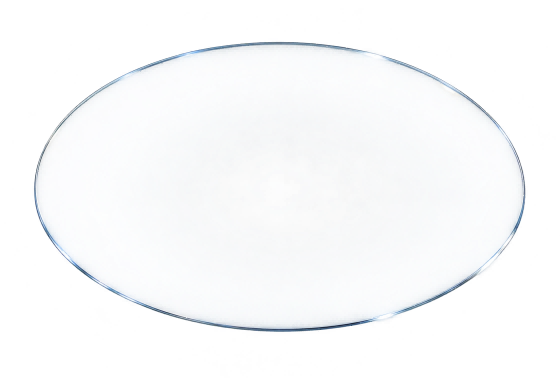
ADVANCED CERAMICS
3D-printed transparent ceramic discs are formed using additive manufacturing processes such as photopolymerization or slurry extrusion. After debinding and sintering, they achieve a dense, light-transmitting structure and can be used for discs and custom geometries that are difficult to produce using conventional molding processes. Transparent ceramics are the material of choice for these products, combining the hardness, wear resistance, corrosion resistance, and electrical insulation of ceramic materials. Designs can also be evaluated for transmission requirements from the visible to infrared wavelengths. Specific transmittance, porosity, strength, dimensional accuracy, and suitable wavelength ranges must be confirmed based on the material system, process, and sample testing.
Product Name: Transparent Ceramic Disc
Product Category: Transparent Ceramics
Material: Transparent ceramics; specific composition, grade, and transmission wavelength range to be confirmed for each project
Forming Process: 3D-printed additive manufacturing; photopolymerization or slurry extrusion processes can be evaluated
Post-Processing: Debinding, sintering, and any necessary surface finishing; the specific process is determined by the geometry and performance requirements
Specifications: Diameter, thickness, flatness, surface finish, transmittance, and dimensional tolerances to be confirmed against drawings and sample requirements
Optical windows and equipment components requiring a light-transmitting barrier
Transparent ceramic functional or protective discs for laser components
Optical path protection and environmental isolation components for optical sensors
Precision electronic assemblies requiring electrical insulation while maintaining light transmission
Research prototypes, small-batch custom products, and development of transparent ceramic samples with complex geometries
Performance:
Under suitable wavelength and surface-quality conditions, provides a stable light-transmitting interface for optical signal transmission or detection.
Leverages the hardness, wear resistance, and corrosion resistance of ceramic materials to help components withstand a degree of mechanical contact and exposure to environmental media.
Additive manufacturing and customized processes can shorten design iteration cycles; however, interlayer bonding, porosity, sintering shrinkage, and light-transmission performance still require sample validation.
Design Selection: Transparent ceramic materials can be selected and evaluated based on transmission requirements from the visible to infrared wavelengths. 3D-printed additive manufacturing supports small-batch customization and rapid iteration for discs and some complex geometries. Debinding and sintering produce a dense ceramic structure; the specific density, light-transmission performance, and mechanical properties depend on process parameters and material grade. Combining high hardness, wear resistance, corrosion resistance, and electrical insulation, these materials are suitable for development of precision optical and functional components. Structural dimensions, tolerances, mounting method, operating temperature, loads, and media conditions must be confirmed based on the drawings and actual operating conditions.
For a quotation, please provide product drawings or sketches, critical dimensions and tolerances, material grade, operating temperature, loads, media, assembly method, surface requirements, quantity, and inspection standards to help determine the material, design, and manufacturing process.