
ADVANCED CERAMICS
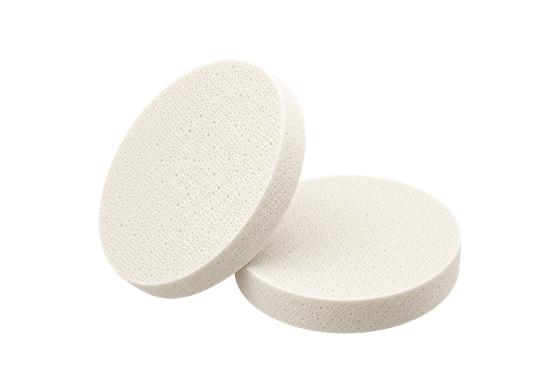
Micro-porous alumina ceramic discs are intended for selecting porous functional components in a flat disc form. With porous alumina as the material basis, designs can be evaluated around properties such as electrical insulation, wear resistance, and corrosion resistance. Actual gas permeability, filtration, strength, and media compatibility depend on the pore structure, material composition, surface condition, and operating conditions, and must be confirmed for the specific application.
Material: Micro-porous alumina ceramic; specific material composition, pore structure, and grade must be confirmed for the application.
Name: Micro-porous alumina ceramic disc.
Form: Flat disc-shaped porous ceramic component; outer diameter, thickness, pore structure, edge condition, and tolerances are subject to the drawing or technical discussion.
Process options: Ceramic forming, sintering, and precision machining as needed; specific processes are evaluated according to structural and performance requirements.
Selection information: Confirm based on the target media, particle characteristics, filtration or gas permeability objectives, flow rate and pressure differential, support method, temperature cycling, and cleaning conditions.
Fluid filtration: For flat filter components whose material, pore structure, and media compatibility have been validated.
Gas permeation and flow distribution: Evaluate for components requiring a degree of gas permeability or gas distribution.
Porous support: Evaluate as a flat porous support or separation component in tooling or equipment.
Semiconductor and electronics manufacturing: Evaluate for use in equipment components where cleanliness, electrical insulation, or wear resistance is required, based on operating conditions.
Laboratory and process equipment: For small filtration, gas-permeable, or media-contact components; confirm the media, pressure, and cleaning method in advance.
Performance:
When pore size distribution and pore connectivity are properly matched, the disc can provide a controlled gas flow or filtration path for the target fluid. Actual flow rate and retention performance must be confirmed through sample testing.
The electrical insulation, wear resistance, and corrosion resistance of alumina ceramic can help meet material selection requirements under relevant operating conditions; specific resistance depends on the material composition, surface condition, and media.
Uniform support, appropriate clamping, and suitable cleaning and maintenance can help reduce the risk of disc failure under pressure, thermal cycling, or contaminant blockage. Load capacity and service life must be validated under actual operating conditions.
Structural Selection: The flat disc structure facilitates integration into filtration, gas-permeable, or porous support assemblies; the shape and mounting method can be evaluated against the drawing. The micro-porous alumina ceramic material offers general properties including electrical insulation, wear resistance, and corrosion resistance. Pore size distribution, pore connectivity, and degree of densification are key considerations in selection and design; flow rate and retention performance must be verified for the product. Design considerations include support and clamping areas, pressure direction, effective working surface, sealing interfaces, and cleaning and maintenance conditions; performance should not be inferred from the product name alone. Dimensions, tolerances, mounting method, operating temperature, load, and media conditions must be confirmed against the drawing and actual operating conditions.
For a quotation, we recommend providing a product drawing or sketch, critical dimensions and tolerances, material grade, operating temperature, load, media, assembly method, surface requirements, quantity, and inspection standard so that the material, structure, and machining route can be confirmed.