ADVANCED CERAMICS
Plates/Fingers
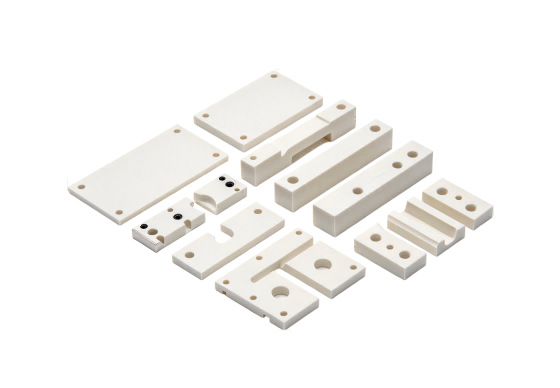
Aluminum nitride plate/finger-shaped structural components are used in precision applications requiring both thermal conductivity and electrical insulation, with geometries customized to drawings.
Product Features
Suitable for applications requiring both thermal conductivity and electrical insulation.
Plate and finger-shaped configurations available.
Thin walls, edges, and thermal cycling require careful verification.
Contact Us
Product Description
Aluminum nitride ceramic plate- or finger-shaped components are designed for equipment structures requiring both heat transfer and electrical insulation. The material grade, manufacturing route, and operating environment should be confirmed for each application.
Basic Information
- Material: Aluminum nitride (AlN);
- Name: Aluminum nitride plate/finger-shaped component;
- Form: Plate or finger-shaped structure; mounting interfaces and holes/slots to be confirmed against drawings;
- Process: Tape casting, dry pressing, isostatic pressing, sintering, and precision machining, selected according to the plate or finger-shaped form;
- Specifications: Dimensions, thickness, flatness, edges, holes/slots, tolerances, and surface requirements to be confirmed against drawings.
Applications and Usage
- Semiconductor: High-thermal-conductivity, electrically insulating plate/finger structures for processes such as wafer handling and lithography.
- Electronics manufacturing: Components providing heat conduction, insulation, and wear resistance for chip packaging and component sorting.
- New energy: Corrosion-resistant plate/finger structures for silicon wafer cleaning and handling.
- Medical/Chemical: Clean, corrosion-resistant structures for material transfer in cleanrooms.
- Optics: High-precision plate/finger structures in lens clamping and transfer equipment.
Performance and Structural Selection
High stiffness and wear resistance can help maintain the dimensions and form of thin-plate and finger-type precision structures; actual performance should be confirmed based on material grade and machining quality. Thermal conductivity and electrical insulation provide a material selection option for components requiring both heat transfer and electrical isolation; actual thermal performance must be tested. Corrosion resistance, temperature resistance, and low thermal expansion can help accommodate clean or temperature-variable environments, but should be validated under thermal cycling and assembly conditions.
When designing, specify plate thickness or finger geometry, mounting interface, heat-flow direction, local loads, edge and slot conditions, operating atmosphere, and thermal cycling conditions, while accounting for ceramic brittleness and assembly stress.
Quotation and Customization
For a quotation, please provide product drawings or sketches, critical dimensions and tolerances, material grade, operating temperature, load, medium, assembly method, surface requirements, quantity, and inspection standard to facilitate confirmation of the material, structure, and machining route.