
ADVANCED CERAMICS
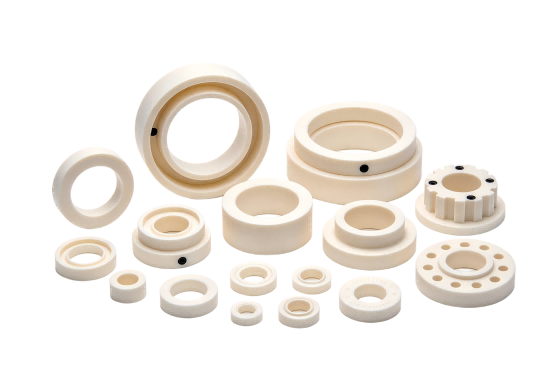
Alumina or zirconia ceramic rings are used in structural designs requiring wear resistance, electrical insulation, or media isolation. The material grade, end faces, coaxiality, and assembly method should be confirmed based on the equipment operating conditions.
Material: oxide ceramics, including alumina or zirconia;
Name: oxide ceramic ring components;
Shape: ring-shaped structure; inner and outer diameters, wall thickness, end faces, and mounting method to be confirmed against the drawing;
Processes: dry pressing, isostatic pressing, injection molding, turning, sintering, and precision machining as required, selected according to the ring geometry;
Specifications: inner and outer diameters, wall thickness, roundness, coaxiality, tolerances, and surface requirements to be confirmed against the drawing.
Semiconductors: Wear-resistant or corrosion-resistant rings for wafer handling, lithography, and other processes.
Electronics manufacturing: Insulating and wear-resistant rings for chip packaging and component sorting.
New energy: Corrosion-resistant rings for silicon wafer cleaning and handling.
Medical and chemical industries: Clean, corrosion-resistant rings for material transfer in cleanrooms.
Optics: High-precision rings for lens clamping and transfer equipment.
High hardness and wear resistance can help meet dimensional and roundness requirements in rotating, positioning, or sealing ring structures; actual performance depends on the material and machining quality. Corrosion resistance, temperature resistance, and electrical insulation can help reduce the risk of metal contamination and electrochemical corrosion, but compatibility with the actual process media must be verified. Proper control of the inner and outer diameters, end faces, coaxiality, and assembly clearances can help reduce the risk of excessive interference, uneven loading, and edge damage.
During design, verify the inner and outer diameters, wall thickness, end faces, coaxiality, support, and fit. Interference fits, localized clamping, uneven loading, and edge notches may increase the risk of ceramic breakage.
For a quotation, please provide product drawings or sketches, critical dimensions and tolerances, material grade, operating temperature, load, process media, assembly method, surface requirements, quantity, and inspection standards. This information will help us confirm the material, design, and machining process.